
Local Angle: Photographing Italian Market Streets as a Visitor Without Getting in the Way
The market opens before the street does. By half past seven the crates are already stacked, the awnings are being cranked out, and the first serious shoppers are moving through with their own bags because they know which stall is worth the queue. Come back at eleven and the same space is loud, crowded, and much harder to photograph.
You are a guest in a place that is somebody's workplace and somebody else's kitchen. That is the whole tension of shooting an Italian market street as an outsider. The good news is that markets are forgiving, provided you learn the rhythm instead of fighting it. Vendors are busy, not fragile. They will ignore you for an hour and then wave you over to show you something. Your job is to be the kind of presence that earns the second half of that sentence.
Learn the Market's Clock Before You Learn Its Faces
Every market street has three distinct moods, and they photograph very differently. Arrival, roughly an hour before the official opening through the first rush, is all labour: crates coming off vans, ice going down, cardboard being broken flat. It is the best light of the day and the least crowded, and people are focused on the job rather than on who is standing nearby.
The middle of the morning is the social market: full aisles, arguments over change, hands everywhere. It gives you the pictures you came for, but it also gives you the most chances to be in the way. Late morning to early afternoon is the wind-down, when stalls start closing, prices drop, and the street is briefly visible again under all the debris. Many markets shut by early afternoon and some don't trade every day, so check the local pattern the evening before rather than turning up with a plan built on guesswork.
Read the Aisle Before You Raise the Camera
Stand at one end of the street for a full five minutes with the camera down. Not shooting. Just look. You are checking the practical geography, and the answers decide where you stand for the next hour.
- Where the flow runs. Which side do shoppers walk down, and where does it bottleneck? That bottleneck is your best backdrop and your worst place to stand.
- Who is stationary. Vendors stay put and make reliable subjects; shoppers move. Build compositions around the fixed points and let people walk through them.
- The delivery routes. There is usually one lane where handcarts and vans push through. Never stand in it, even for a second, even for a great frame.
- The light. Note where the awnings open to sky and where the street narrows into shade. That contrast is your main working material.
- The quiet corners. A stack of boxes, a doorway, a step. These are where you can stand without being felt.
Buy Something First, Ask Second, Photograph Third
A euro of fruit changes the dynamic more than any amount of charm. Buy something from the stall you want to photograph, take the receipt, and you are no longer a person hovering with a lens; you are a customer who happens to be interested. Say buongiorno when you arrive and grazie when you leave, and use a raised eyebrow and a gesture toward the camera as a question. "Posso?" covers most of it.
Learn to read the answer. A nod, a shrug, or a small wave means carry on. A flat hand, a head shake, or a turned shoulder means no, and that is the end of the conversation, not the opening of a negotiation. Some vendors will pose, which is rarely the photograph you wanted; thank them and move on. Also watch the stall itself: a hand-painted sign, a cloth over a crate, or a vendor stepping behind a display is often a signal that the camera is not welcome right now. Respect it and come back on another day.
Work the Edges, Not the Middle
The centre of the aisle is where bad market photographs come from. You are in everyone's path, your shadow is in the frame, and you end up shooting the backs of heads. Move to the side and shoot along the street instead of across it. Lean against a pillar at the corner of a stall, let the crowd flow past a metre in front of you, and wait.
A wide-to-normal prime is the honest tool here: something around 28mm or 35mm, small enough to go unnoticed and wide enough to include the crates, the hands, and the archway behind. Set the camera before you need it. With a 35mm at f/8 and the focus pulled to roughly two metres, almost everything in a market aisle is acceptably sharp, and you can shoot from chest height without lifting the camera to your eye. That single habit — camera at the sternum, screen off, shooting by feel — will get you closer to real gestures than any long lens pointed from across the street.
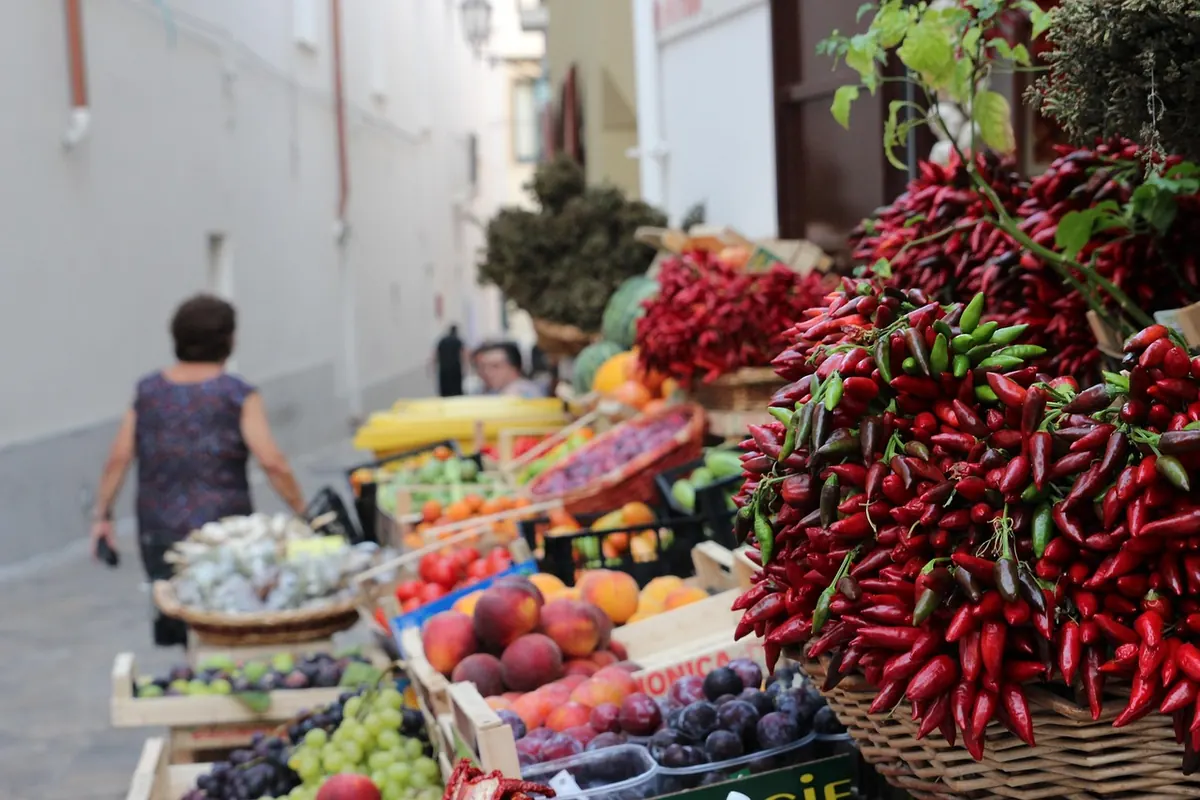
Look for layers rather than single subjects: a foreground of crates, a middle band of hands and scales and paper bags, and a background of balconies or a church façade closing the frame. Then wait for one element to move through it. Artichoke leaves, fish on ice, tomatoes stacked in pyramids, the repeated geometry of hanging bags — the market hands you pattern. Your only task is to stand still long enough for a person to break it.
Expose for the Awning, Not the Face
Market light is contrast, and contrast is what makes these photographs feel like the place. Under a white canopy the highlights will blow out long before the faces do, so expose so the canvas or the ice keeps its detail; the shade underneath will fall where it falls. That is the look. Chasing faces with exposure compensation flattens the whole scene into something that could have been shot anywhere.
Skip the flash. It announces you, disturbs the stall, and kills the one thing that makes a covered market interesting. Raise the ISO instead; grain in a fish market at 9am is not a problem, it is texture. And look for the gaps: the bright slot at the end of an aisle, the sun coming through between two awnings, the moment someone walks through a shaft of light carrying a crate. Those frames are worth more than a hundred evenly lit portraits.
Know When to Lower the Camera
Some situations are simply not yours to photograph. An argument between a vendor and a customer, someone being told off, a person counting cash, a family in obvious distress, a child photographed close up without a parent's clear agreement — leave all of it alone. A funeral or a religious procession moving down a market street is not a photo opportunity; step aside and let it pass.
Publishing is a separate decision from taking. Norms around identifiable people in photographs are stricter in Italy and across the EU than many visitors assume, and a market portrait that feels fine on the back of the camera can be a different matter once it is on a website. If you plan to publish, be conservative, ask when in doubt, and take local advice on your specific use rather than relying on what other photographers do.
A Workable Market Morning
Arrive early, walk the length of the street once without shooting, then choose two positions and stay in each for twenty minutes. Buy something small from a stall you like, ask with a gesture, and accept the first no without pushing. Keep the camera low, the lens short, and the flash off. Leave before the market closes so you are not competing with the pack-up.
That is the whole method: less moving, more waiting, and a bit of respect for the people whose morning you are borrowing. The photographs that come out of it will look like the street actually felt.
Photo: Samueles / Pixabay