



Window Displays as Photo Stories: Building a Three-Image Narrative from One Storefront
A shop window is the only stage where the set is already built when you arrive. Someone else chose the lighting, the props, the colour of the backdrop, and then walked away. What is left is a small theatre of commerce, and it is one of the most generous subjects a street photographer can find — provided you resist the urge to take a single flat photograph of the whole thing and instead tell a story in three frames.
Three Frames, One Story
Three is a useful number because it forces decisions. One photograph of a window is a record: here is a shop, here is what it sells. Two photographs still feel like a comparison. Three photographs, shown together, start to behave like a sentence — the eye moves from the first to the second to the third and constructs meaning in the gaps.
The structure that works most reliably is simple: detail, context, mood. First the thing that caught you, close and specific. Then the wider frame that tells us where that thing lives. Then a final image that gives the whole set a temperature — dusk light, a passerby, rain on the glass, an empty street. You are not covering the window from three angles. You are answering three different questions about it: what, where, and how does it feel.
Frame One: The Detail
Start with the smallest thing that made you stop walking. It is rarely the whole window. It is the chipped gilt lettering on the glass, the handwritten card in blue biro with a price on it, the single mannequin hand turned palm-up, the bowl of lemons that has been there so long the skins have gone dull. That detail is your hook, and it should be just ambiguous enough to make a viewer want the next photograph.
Get close. A 50mm lens is plenty; a short telephoto or a macro gives you room to isolate. The technical problem is glass, and it has three parts. Rest the lens hood against the window to cut reflections if the shop is lit and the street is dark. If you cannot touch the glass, move your body rather than the camera — reflections slide away as you shift sideways, and what looks like a permanent bright smear is often gone thirty centimetres to the left. Decide deliberately whether you are focusing on marks on the glass or objects behind it; you cannot usually have both, and the choice changes the photograph completely.
Resist tidying. A smudge, a fingerprint arc, a strip of old tape across the corner — these are the details that make a window feel used rather than photographed. Your detail frame can be almost abstract. It does not need to explain the shop. It needs to be worth looking at on its own.
Frame Two: The Context
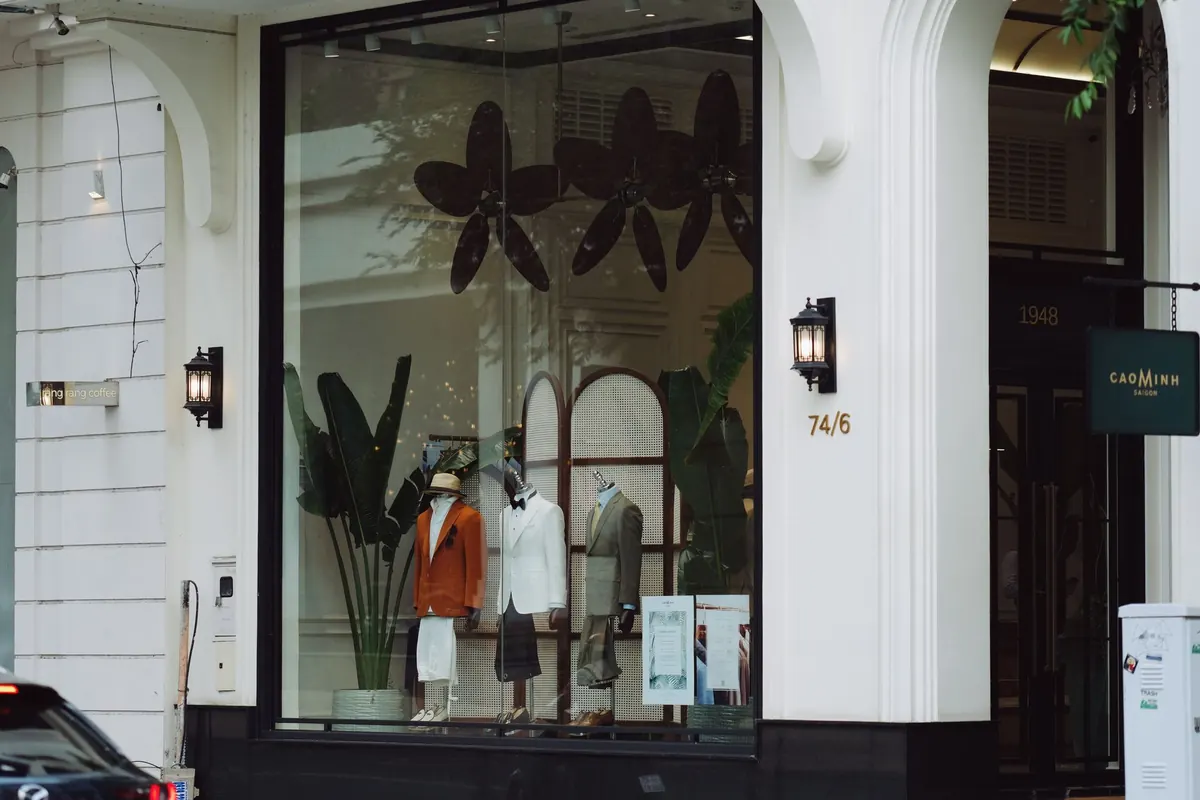
Step back and show the window in its street. This is where you tell the reader what kind of place they are in: the awning, the number above the door, the kerb, the bin, the parked scooter, the neighbouring sign that undercuts or repeats the message. Context is not background. It is half the story.
Wide enough to include the frame of the window, but not so wide that the shop becomes a small rectangle in a busy street. If you are using a wide lens, watch the edges — wide lenses bend the architecture, and a shopfront that leans backwards looks like carelessness rather than style.
Keeping verticals honest
Shop windows live or die by their straight lines. Keep the camera level and the sensor parallel to the glass, then step back far enough that the whole frontage fits without tilting upward. If you must tilt, leave room at the bottom and correct it later. A set of three photographs where one has a crooked doorframe will feel sloppy no matter how good the individual images are.
This frame is also your best chance to include a person. Someone reading the menu taped to the glass, a courier checking a phone, a child at the height of the display — a human figure at the window turns a shopfront into a scene. Wait. Give it four or five minutes before you settle for nobody.
Frame Three: The Mood
The last frame is not more information. If you have already shown the detail and the context, a third explanatory photograph will make the set feel like a catalogue. What you want instead is atmosphere — the thing that makes a viewer pause on the final image.
This is the frame to shoot at dusk, when the interior light spills out and the street goes blue. Or in rain, with headlights dragging across the glass. Or late at night with half the display switched off, so the window becomes a lit box in a dark wall. Underexposing by a stop or so is often the right call here: it deepens the shadows around the window and lets the display do the glowing.
Reflections belong in this frame, and they carry meaning. A window that shows the shop and, faintly, the street behind you is telling two stories at once. Look for a reflection that rhymes with the display — a bare tree in the glass of a florist, a bus in the glass of a shoe shop. That coincidence is worth waiting for.
Making the Three Agree
Shoot all three frames in one visit, ideally within twenty or thirty minutes. A set assembled from three different days will drift apart in light, colour and mood, and viewers feel that drift even when they cannot name it. Before you leave, check:
- Light direction. The same sun angle across all three keeps the set coherent.
- Colour temperature. Mixed daylight and tungsten is fine, but it should be mixed the same way in every frame.
- Aspect ratio. Choose square, 4:5 or 3:2 and stay with it. Consistency is half the storytelling.
- Black and white or colour. Not both. Decide at the window, not afterwards.
- One strong frame. At least one of the three should stand alone if a viewer saw it by itself.
Sequence detail, context, mood in that order for most sets, because it mirrors how attention actually works: something catches the eye, then the eye widens, then it settles. Occasionally mood first and detail last works better — try it before you commit.
When the Window Fights Back
Some windows are hostile. Glare eats the display, the interior is a jumble, a mannequin stares at you like an accusation. A few fixes worth trying:
- Move to the other side of the doorway; the reflection of a parked car is usually worse than the reflection of an empty pavement.
- Come back at a different hour — mid-morning and late afternoon give very different glass.
- Use a polarising filter to cut glare, but accept the two-stop loss and check your shutter speed.
- Photograph the reflection as the subject rather than fighting it. Sometimes the street in the glass is the better picture.
- If staff are watching, buy something small or simply nod and move on. Be unobtrusive, and never photograph customers in a way that makes them uncomfortable.
A Practical Workflow
- Walk past once without a camera in your hand. Note the one detail that stops you.
- Shoot the detail first, while your attention is still fresh and narrow.
- Cross the street and shoot the context, then wait a few minutes for a figure to enter the frame.
- Check the time. If golden hour or dusk is close, wait for it and shoot the mood frame then.
- Review the three on the back of the camera before you walk away. If any of them feels like filler, it is.
- Edit as a set, not as three separate pictures — match the brightness and colour, then ask whether the sequence makes you look twice.
One window, three photographs, twenty minutes. It is a small discipline, but it changes the way you walk down a street: every storefront becomes a potential page.
Photo: Pew Nguyen / Pexels