Prime vs. Zoom Lenses for Street Photography: Which One Helps You React Faster?
You see it half a second before it happens: a man in a flat cap stepping off the kerb into a stripe of light, a woman laughing at a bus stop with her hand over her mouth. The camera comes up. And then, if you are carrying a zoom, comes the pause — a small twist of the wrist while the moment holds its breath. With a prime there is no twist. There is only the frame you already know and the shutter.
That half second is what photographers are really arguing about when they ask which lens helps them react faster. It is not mostly about autofocus. It is about how many decisions sit between your eye and the picture.
Where reaction speed actually gets lost
Break a street photograph into stages and you can see exactly where time disappears. First you notice something. Then you raise the camera. Then you frame. Then you press. Each stage costs something, and a lens choice shifts the cost from one stage to another rather than removing it.
Noticing happens before the camera is involved at all, and it rewards attention and familiarity with a place. Raising is partly physical — a small body and a light lens come up faster, and a heavy zoom held at chest height for two hours comes up slower by the afternoon. Framing is where the real difference lies. A zoom inserts a decision at the worst possible moment, when the subject is already moving and the light is already changing. A prime moves that decision backwards, into the hours before, when you chose the lens and worked out where to stand.
Pressing is the last cost, and the cheapest to fix. Learn the half-press, set your focus mode deliberately, and stop reviewing pictures between shots. Chimping is a reaction-speed problem far more often than gear is.
Primes: the frame you already know
A single focal length is a training tool that happens to make better pictures. Put a 35mm equivalent on the camera and leave it there for a month and something quietly rewires. You start to know, without lifting the camera, roughly what will be inside the frame from three metres away. You learn to step left instead of twisting right. You begin to see the photograph and the crop at the same time, which is exactly what fast street work requires.
The practical gains are cumulative. The lens is smaller and lighter, so it comes up faster and sits more comfortably at hip height. On mirrorless bodies with in-body stabilisation, a fast prime also buys you shutter speed in shade and doorways where a kit zoom would push you to a noisy setting. And a wide aperture gives you separation when the background is a mess of parked cars and shop signs.
The cost is obvious: you have to move. Sometimes you cannot. A subject across four lanes of traffic, a face above a crowd, a detail on a wall behind a fence — a prime will simply miss those, and cropping afterwards only gets you so far before the file falls apart.
What primes reward
- Anticipation. You commit to a distance and a perspective, which forces you to read scenes earlier.
- Speed of raising. Less weight, shorter barrel, fewer things to touch.
- Consistency. A whole series shot at one focal length hangs together in a way mixed framings rarely do.
- Invisibility. Small lenses attract less attention, and attention is the enemy of a natural expression.
Zooms: one lens, many frames
The case for a zoom is not laziness. It is coverage. A 24–70mm equivalent lets you work a single corner properly: the wide shot of the whole scene, the tighter frame of the woman at the newspaper stand, the detail of the coins in her hand. With a prime you would be walking, and walking changes the perspective, which changes the picture in ways you may not want.
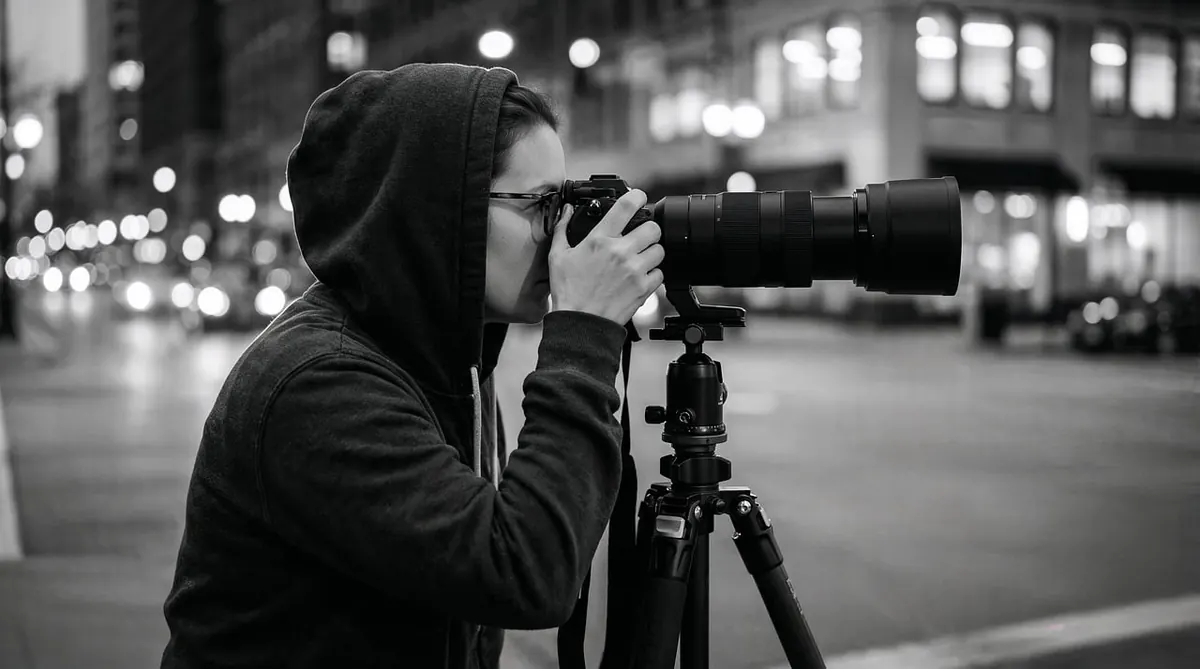
Longer zooms are their own discipline. A 70–200mm compresses a street into overlapping layers and lets you shoot across a road, a market or a river without crossing it. For shy photographers, that physical distance is worth a great deal: you can photograph people at their actual size without standing in their space. Telephoto compression is also a look in its own right, stacking signs, heads and rooftops into a flattened pattern.
Where a zoom costs you
The zoom ring invites hesitation. Standing in front of a good scene, it is easy to make five slightly different frames instead of one decisive one, and to keep adjusting while the light moves on. Bigger barrels and hoods also read as "serious camera" to the people around you, which changes how they behave. And most zooms are slower to open up, which matters most in the low light where street photography often lives.
Discretion is part of speed
A lens you feel awkward carrying is a lens you shoot slowly with. This is not vanity; it is mechanics. A small camera held at chest height, screen tilted, lens pointed roughly forward, gets pictures that a large rig cannot, because nobody adjusts their face for it. Hoods come off. Straps get shortened. Whatever you carry, learn to shoot without lifting the camera to your eye — waist-level framing lets you hold a scene for a minute or two without anyone deciding you are photographing them.
If you shoot a zoom, consider treating it as a set of primes: pick 28mm for the walk to the station, 50mm for the market, and resist the middle ground. You keep the flexibility for the odd occasion when you need it, and you stop paying the framing tax on every shot.
Setups and what they suit
- 35mm equivalent prime, f/2 or faster. The default street lens. Close enough for context, wide enough for interiors, small enough to forget.
- 28mm equivalent prime. For crowds, crossings and tight pavements; rewards getting close and accepts a little distortion.
- 50mm equivalent prime. Good for isolating people in a busy frame and for photographers who dislike being near strangers.
- 24–70mm equivalent zoom. Best for travel, markets and days when you cannot predict the distances you will be working at.
- 70–200mm zoom. For layered compression, shooting across streets, and anyone who needs distance to feel comfortable.
A one-week test you can actually run
- Pick one focal length — 35mm equivalent is the safest bet — and set your zoom to it, or mount the prime.
- Tape the zoom ring if you lack self-control. It sounds childish and it works.
- Shoot for five days without changing it. Walk the same two or three routes at different hours.
- Note, in a sentence or two each evening, the shots you missed and why: too close, too far, too slow to raise.
- At the end of the week, review the misses. If most of them were distance problems, a zoom will genuinely help you. If most were timing problems, it will not.
What to carry tomorrow
If you are still learning to see, take the prime. One focal length removes a decision at the exact moment you can least afford one, and it teaches you where to stand — the skill that outlasts every piece of equipment you will ever buy. If your days are unpredictable, if you shoot markets, protests, travel or family events alongside your street work, take the zoom and discipline yourself to use it in fixed positions except when the picture demands otherwise.
The lens that helps you react fastest is the one you stop thinking about. That is usually the small one, the familiar one, the one already in your hand before the man in the flat cap reaches the kerb.
Photo: geralt / Pixabay